
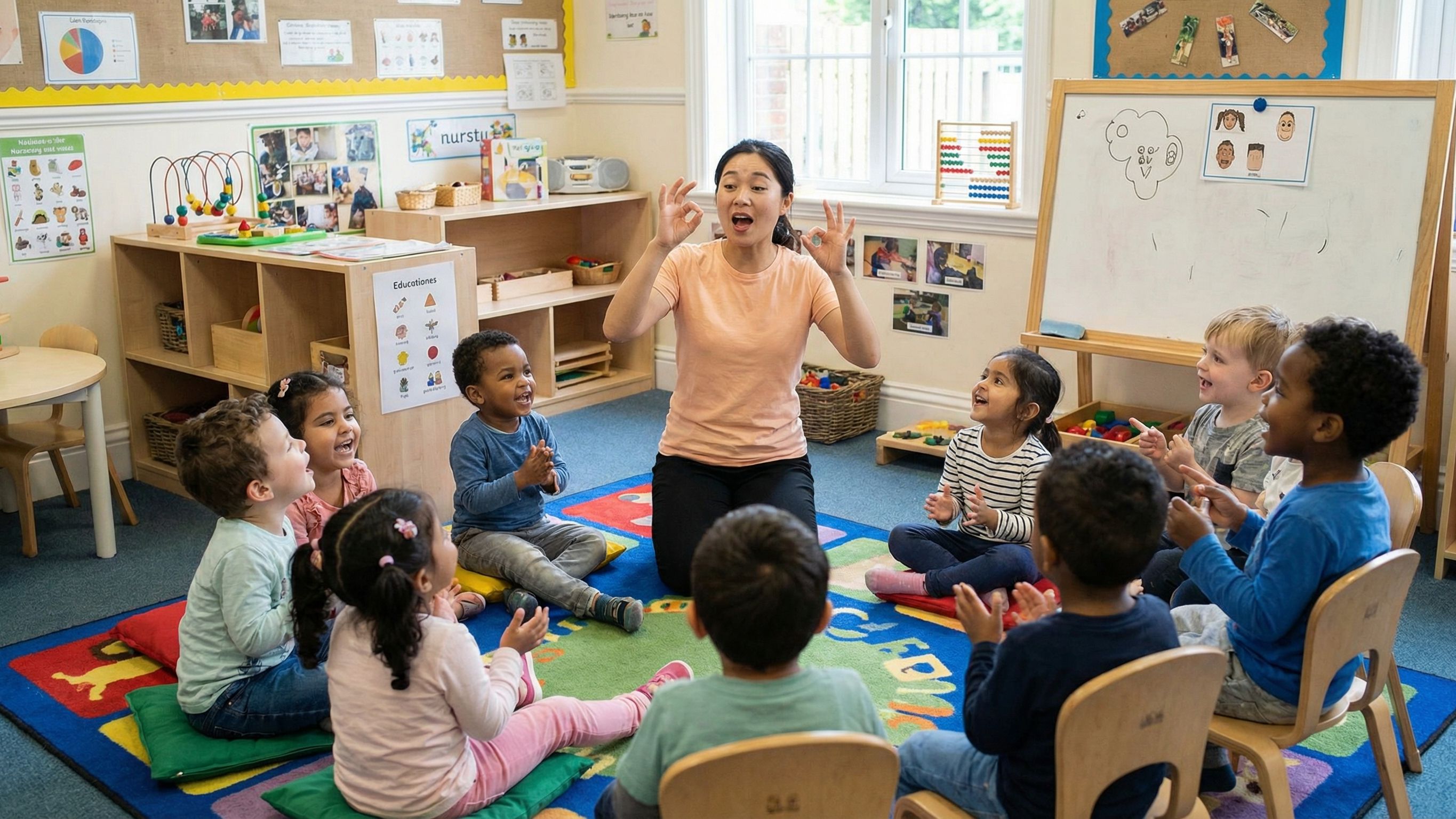
How Stories Train Behaviour & Attention in Primary Schools
Jan 09, 2026The Hidden Power of Stories: Training Behaviour and Attention in Primary Schools
URL Slug: behaviour-attention-training-through-storytelling
Meta Title: How Stories Train Behaviour & Attention in Primary Schools | Mando School
Meta Description: Discover why schools choose storytelling for behaviour training. Learn how stories naturally teach sitting, listening, turn-taking and self-control in early years and KS1 classrooms.
Article Summary
When schools invest in storytelling programmes, they're not just buying language development. They're purchasing something far more valuable: a proven method for training the fundamental behaviours that make learning possible. Stories naturally teach children to sit still, listen attentively, wait their turn, and exercise self-control. These are the building blocks of classroom success, and they matter more to headteachers and teachers than vocabulary or grammar ever could. At MANDO SCHOOL, we understand that before children can learn to read, write, or calculate, they must first learn to be learners. Our storytelling approach trains these essential behaviours through engagement rather than enforcement, creating classrooms where children want to listen because they're genuinely captivated. This isn't about managing behaviour through rewards and sanctions. It's about building the neural pathways and habits that transform a group of lively four-year-olds into a focused, attentive learning community. When a Reception class can sit together for a 15-minute story, maintaining attention and participating appropriately, they're demonstrating skills that will serve them throughout their educational journey. That's what schools are really buying when they choose story-based learning.
What Schools Are Really Buying
Walk into any headteacher's office and ask them what keeps them awake at night. They won't say "phonics scores" or "writing levels." They'll tell you about children who can't sit still, who shout out constantly, who struggle to take turns, or who simply cannot focus for more than thirty seconds.
These aren't learning problems. They're behaviour and attention problems. And they're the real barrier to everything else schools are trying to achieve.
When schools choose a storytelling programme like MANDO SCHOOL, they might think they're buying language development. But here's the truth: language is the bonus. What they're actually purchasing is a systematic way to train the fundamental behaviours that make learning possible.
The Four Pillars of Learning Behaviour
1. Sitting: The Foundation of Focus
Before a child can learn anything in a classroom setting, they need to be able to sit. Not just physically placing themselves on the carpet, but genuinely settling their body and being present in one place.
Stories train sitting because they give children a reason to stay put. When a teacher launches into a captivating tale, children naturally want to remain where they are to find out what happens next. This isn't compliance gained through stern warnings or reward charts. It's voluntary engagement.
Over weeks and months of daily storytelling, children's capacity to sit comfortably and calmly extends. What begins as three minutes in Nursery gradually becomes 15 or 20 minutes in Reception. The training happens so naturally that nobody notices it's happening, but the results are transformative.
2. Listening: The Gateway to Learning
Listening is perhaps the most critical skill for academic success, yet it's one of the hardest to teach directly. You can't force a child to listen. You can demand silence, but true listening requires active cognitive engagement.
Stories train listening because they require it. To follow a narrative, to anticipate what comes next, to understand why characters make certain choices, children must listen attentively. They're not just hearing words; they're constructing meaning, making predictions, and holding information in their working memory.
At MANDO SCHOOL, our stories are specifically crafted to reward listening. Details matter. Repetitive refrains give children anchor points. Plot twists surprise those who've been paying attention. Children quickly learn that listening brings rewards: understanding, enjoyment, and the satisfaction of being "in" on the story.
This type of listening practice transfers directly to every other part of the school day. A child who has learned to listen carefully to a story will listen more effectively to instructions, explanations, and their peers.
3. Turn Taking: The Social Foundation
Classrooms only function when children can take turns. Turn-taking in speaking, in activities, in getting the teacher's attention. Without this skill, chaos reigns.
Interactive storytelling is essentially a masterclass in turn-taking. When a teacher pauses and asks "What do you think will happen next?", children must wait for their opportunity to contribute. When the story includes call-and-response elements, children learn to come in at the right moment, not whenever the urge strikes them.
MANDO SCHOOL stories build in multiple opportunities for structured participation. Children might repeat a magical phrase, suggest what a character should do, or make sound effects at appropriate moments. Each of these is a turn-taking exercise disguised as fun.
The beauty of this approach is that children are motivated to wait for their turn. They want to participate, so they learn to control their impulse to shout out. They begin to understand that everyone gets a chance, but only if we all respect the system.
4. Self-Control: The Key to Everything
Self-control might be the single most important predictor of academic and life success. Children need to control their bodies, their impulses, their emotions, and their attention.
Stories train self-control in multiple ways. Children must control the urge to call out, to fidget excessively, to get up and wander off. They must manage their emotional responses when stories become exciting, sad, or suspenseful. They must delay gratification, waiting through the slow build-up to reach the satisfying conclusion.
Research shows that these moments of practiced self-regulation strengthen the neural circuits responsible for executive function. Every time a child stops themselves from interrupting, they're building stronger self-control for the future.
At MANDO SCHOOL, we understand that self-control is like a muscle. It needs regular, appropriate exercise to grow stronger. Our stories provide that daily workout in a context that feels nothing like hard work.
Why This Matters More Than Language
Don't misunderstand: language development is important. Vocabulary, grammar, narrative structure, these all matter enormously. But here's the hard truth that every experienced teacher knows: you cannot teach language to a child who cannot sit, listen, take turns, or exercise self-control.
Those foundational behaviours are the prerequisite for all other learning. Without them, even the most brilliant curriculum falls flat. With them, children can access everything education has to offer.
This is why schools struggling with behaviour choose storytelling interventions. It's why MANDO SCHOOL sees such dramatic results not just in language assessments, but in overall classroom climate and learning outcomes.
The MANDO SCHOOL Difference
At MANDO SCHOOL we've designed our entire approach around this understanding. Our stories aren't just entertaining narratives; they're carefully structured behaviour training tools.
Every story includes:
Moments of stillness that train sitting and calm attention Listening checkpoints where details from earlier in the story become important Participatory elements that practice turn-taking and appropriate contribution Emotional arcs that give children practice managing their responses Satisfying conclusions that reward children for their sustained attention and self-control
Our training for teachers emphasises these elements just as much as the language content. We help educators understand that they're not just telling stories; they're systematically developing the behavioural foundations for learning.
The Long Game
The effects of this training extend far beyond the story time carpet. When an entire class has been through months of daily storytelling practice, teachers report transformation in every area of school life.
Children line up more calmly. They listen to instructions more reliably. They participate in discussions more appropriately. They can focus on their own work for longer periods. They handle transitions more smoothly.
These aren't separate improvements. They're all manifestations of the same underlying development: children have been trained in the fundamental behaviours of being a learner.
And here's the beautiful part: this training doesn't feel like training to the children. They're not sitting through behaviour management programmes or earning points on a chart. They're just enjoying brilliant stories, day after day.
The behaviour training happens as a natural consequence of genuine engagement. That's what makes it so powerful and so sustainable.
What This Means for Your School
If you're a headteacher, SENCo, or early years leader, this reframes how you might think about storytelling provision.
You're not choosing between behaviour management and language development. You're choosing a tool that delivers both, with behaviour training as the primary mechanism and language development as the natural result.
You're not adding another initiative to your already crowded schedule. You're implementing a practice that makes everything else work better because it creates the conditions for learning.
You're not buying an expensive add-on. You're investing in the foundation that every other educational investment depends upon.
The Evidence in Your Classroom
You'll know this approach is working when you see:
Children settling more quickly at the start of story time Sustained attention gradually increasing week by week Fewer interruptions and shout-outs during stories More children able to recall and discuss story details Better turn-taking during participatory moments Improved behaviour spilling over into other parts of the day Children asking for stories and being disappointed when they're missed
These observable changes are the evidence that real behaviour training is taking place. And they're the foundation for everything else you're trying to achieve.
Moving Forward
The choice facing schools isn't really about which language programme to adopt. It's about recognising what children actually need to thrive in an educational setting.
They need to learn how to sit comfortably in a group. They need to develop the capacity to listen actively. They need to practice taking turns in a structured way. They need to build their self-control muscle.
Stories train all of this, naturally and joyfully. That's not the secondary benefit; it's the primary purpose.
At MANDO SCHOOL, we've built our entire approach on this foundation. We sell behaviour and attention training through language because we understand what schools truly need.
The language development is real, significant, and well-documented. But it's the behaviour transformation that changes classrooms. And that's what matters most.
Ready to transform behaviour through storytelling? Visit MANDO SCHOOL to discover how our approach trains the foundational skills that make all learning possible.
Stay connected with news and updates!
Join our mailing list to receive the latest news and updates from our team.
Don't worry, your information will not be shared.
We hate SPAM. We will never sell your information, for any reason.
