
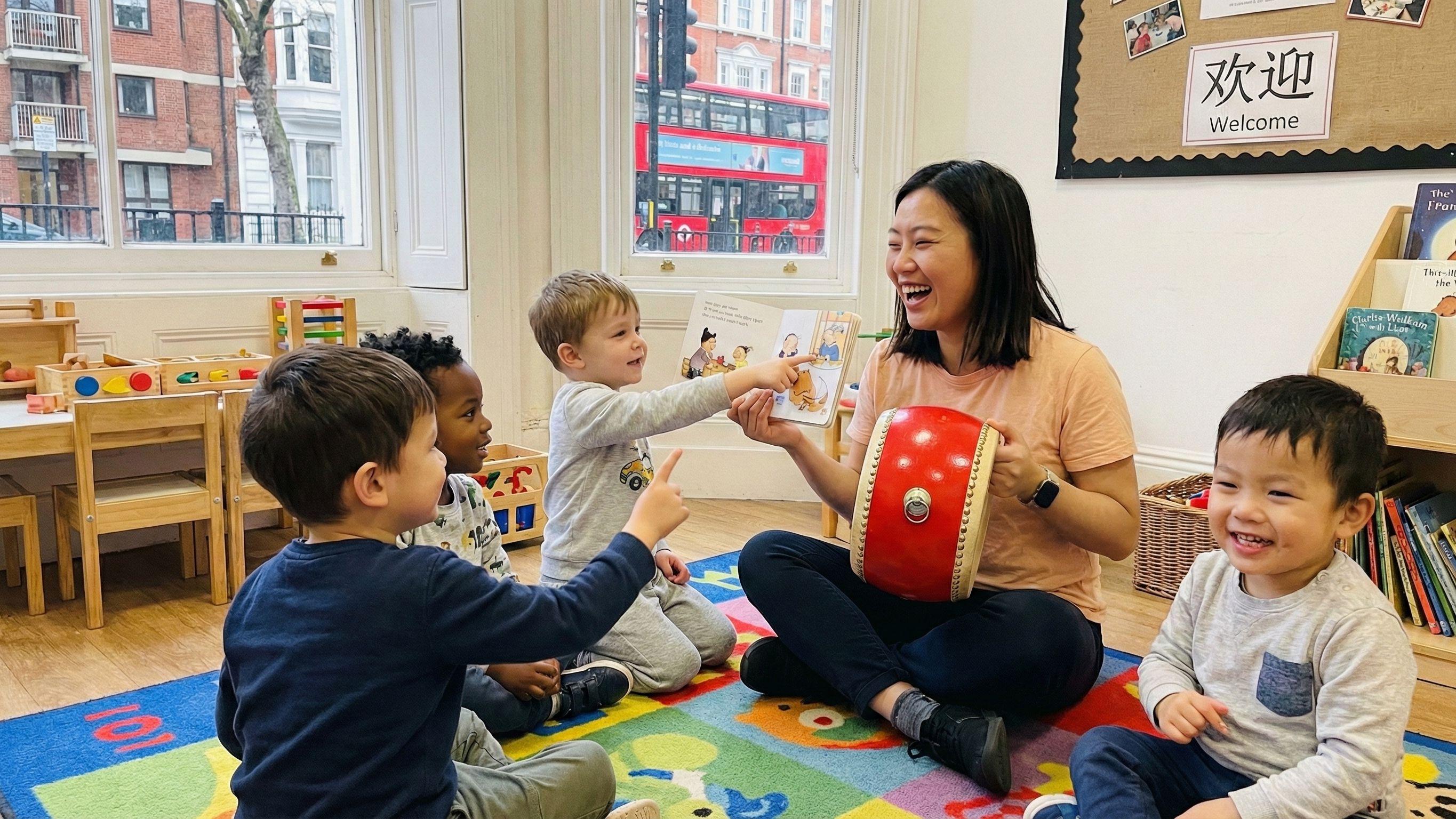
Beyond Words: Why Mandarin is the Secret to Early Years Communication and Cognitive Growth
Jan 26, 2026In the fast-paced world of London’s early years sector, nursery managers and headteachers are facing a unique set of challenges in 2026. With the recent expansion of funded childcare and a shifting economic landscape, the focus is squarely on providing "added value" that truly impacts a child’s development.
One of the most effective ways to do this is through early language enrichment. Far from being an "extra" activity, Mandarin Chinese is increasingly seen as a vital tool for boosting communication, cognitive flexibility, and confidence in children aged 2 to 5.
The "Golden Window" of Brain Development
Research in neuroscience consistently shows that the period between birth and age five is the "critical period" for language acquisition. During this time, children's brains are exceptionally plastic.
-
Auditory Sensitivity: Studies from the University of Washington reveal that infants are born "citizens of the world," capable of distinguishing sounds from all languages.
-
The Tonal Advantage: Mandarin is a tonal language. Research suggests that learning tones early in life actually enhances a child’s musical pitch perception and auditory processing. This "tunes" the ear in a way that non-tonal languages like English cannot.
-
Cognitive Flexibility: Bilingual children often outperform their monolingual peers in "executive function"—the ability to switch between tasks and solve complex problems.
Supporting the EYFS and Boosting Progress
For nurseries, aligning enrichment with the Early Years Foundation Stage (EYFS) is essential. Language learning directly supports the Prime Area of Communication and Language.
The Education Endowment Foundation (EEF) notes that high-quality communication and language approaches can help children make up to seven months of additional progress over the course of a year. By introducing Mandarin, you are providing a high-impact environment that encourages:
-
Focused Listening: Distinguishing between the four tones of Mandarin requires high levels of attention.
-
Vocabulary Expansion: Learning new labels for objects and feelings strengthens the child’s overall "language-learning muscle."
-
Social Inclusion: Exploring a global language fosters early cultural awareness, a key part of Personal, Social and Emotional Development (PSED).
Future-Proofing for the Next Generation
The benefits extend beyond the nursery gates. According to the British Council’s Language Trends report, Mandarin is a high-priority language for the UK’s future economy.
-
Business Demand: A survey of UK business leaders found that 77% believe speaking Mandarin gives young people a significant career advantage.
-
Global Awareness: In a city as diverse as London, Mandarin helps children see themselves as global citizens from the very start.
📖 The Parent’s Mini-Guide: Why Your Child is Learning Mandarin
Share this section with your families to help them understand the benefits of our sessions!
1. It’s about more than just words. Learning Mandarin at age 3 or 4 isn't just about vocabulary. It’s brain exercise! It improves problem-solving skills and creative thinking.
2. Tones help with "active listening." Because Mandarin uses different tones to change the meaning of words, children become much better at listening carefully to sounds and patterns.
3. It builds confidence. Our sessions at MANDO SCHOOL use songs and games. When children successfully learn a new way to say "hello" or "thank you," their self-esteem soars.
4. A window to the world. London is a global city. Early exposure to different cultures helps children grow into kind, curious, and inclusive individuals.
How MANDO SCHOOL Fits Your Routine
At MANDO SCHOOL, we understand that nursery staff are busier than ever. Our programme is designed to be "plug-and-play," requiring no extra preparation from your team. We use a story-led and play-based approach that mirrors how children naturally learn.
"Mandarin has become the highlight of our week. The children don't feel like they are 'studying'—they are playing, singing, and moving. It has given our quieter learners a whole new way to express themselves." — Senior Leader, London Academy Trust
Our sessions include:
-
Interactive Stories: Building narrative skills.
-
Traditional Songs: Enhancing rhythm and rhyme.
-
Movement Games: Linking physical actions to new vocabulary.
Take the Next Step
Providing world-class enrichment doesn't have to be complicated. Our classes are designed for nurseries, primary schools, and after-school clubs, fitting seamlessly into your existing schedule.
Ready to see the impact in your setting? Visit
Stay connected with news and updates!
Join our mailing list to receive the latest news and updates from our team.
Don't worry, your information will not be shared.
We hate SPAM. We will never sell your information, for any reason.
