
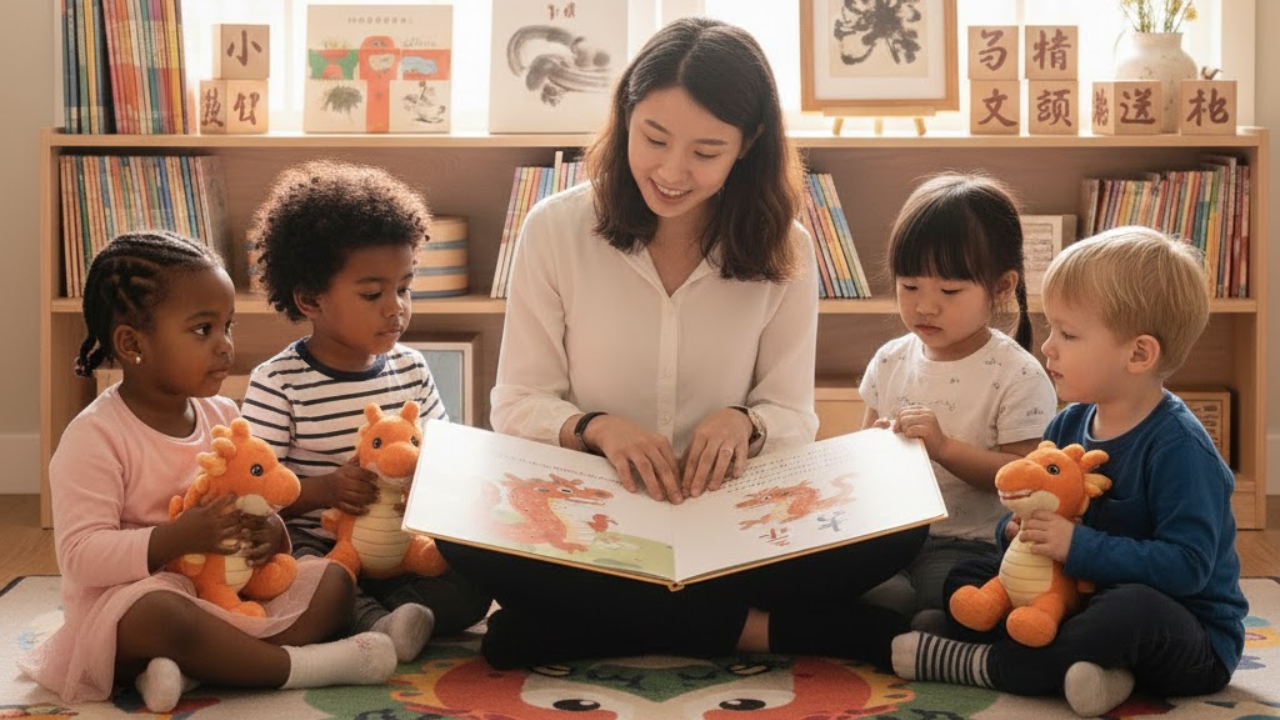
Little Dragons: Why Story-Led Mandarin Adventures Are Perfect for Your Under-5s
Nov 30, 2025Remember when your toddler learnt "The Wheels on the Bus" and sang it approximately 47 times a day? That's the magic of early language learning, and it works brilliantly for Mandarin Chinese too.
As a nursery practitioner or parent of an under-5, you're witnessing the most extraordinary period of language development. Between birth and five years old, children's brains are neurologically primed for language acquisition, forming over one million neural connections every second. So why not add a few thousand Mandarin ones into the mix?
Why Mandarin? Why Now?
Let's be honest: Mandarin Chinese has a reputation for being "difficult." But here's the secret: it's only difficult for adults. Young children don't yet have the anxieties and preconceptions we've developed. They haven't decided that tones are tricky or that characters are impossible. To a three-year-old, "nǐ hǎo" (hello) is just as fun to say as "hello", perhaps even more so, with its bouncy rhythm.
Research from institutions like University College London has shown that children exposed to multiple languages from an early age develop enhanced cognitive flexibility, better problem-solving skills, and improved executive function. Plus, with Mandarin being spoken by over a billion people globally, you're genuinely opening doors for your little ones.
The Story-Led Approach: Once Upon a Time in Beijing
Traditional language teaching (flashcards, rote repetition, grammar drills) makes most adults want to nap. Imagine how a four-year-old feels! This is where story-led learning becomes pure gold.
Picture this: Instead of drilling "panda" (熊猫, xióngmāo), you tell the tale of Ping the Panda who's lost in the bamboo forest. Children help Ping find his way home, meeting a tiger (老虎, lǎohǔ), a dragon (龙, lóng), and a cheeky monkey (猴子, hóuzi) along the journey. They're not memorising vocabulary—they're rescuing Ping!
This narrative approach taps into what Dr Opal Dunn, a renowned specialist in early language learning, calls "holistic language acquisition." Children absorb language through meaningful context rather than isolated words. The story becomes a scaffold for memory, with characters and plot points serving as natural retrieval cues.
Real-World Magic in Action
At Little Sprouts Nursery in Manchester, practitioners introduced a weekly "Mandarin Story Time" featuring tales like "The Magic Paintbrush" and "Journey to the West." Within six weeks, their three-year-olds were spontaneously using phrases like "xièxie" (thank you) and "zàijiàn" (goodbye) during free play—not because they'd been drilled, but because they'd lived these words through story.
Get Moving: Kinesthetic Learning That Sticks
Ever tried to teach a toddler to sit still for 20 minutes? Enough said.
Young children are kinesthetic learners: they need to move, touch, and physically experience concepts. This is particularly powerful for Mandarin, where physical actions can reinforce tonal patterns and meaning.
Action-Packed Activities to Try
Animal Olympics: Create an obstacle course where children become different animals at each station, shouting the Mandarin name as they go. Hop like a rabbit (兔子, tùzi), stomp like an elephant (大象, dàxiàng), slither like a snake (蛇, shé). The physical memory anchors the vocabulary far more effectively than any flashcard.
Growing and Shrinking Game: Teach size concepts through full-body movement. Children crouch down tiny for "xiǎo" (small) and stretch up tall for "dà" (big). Add in medium (中, zhōng) and watch them find their middle height. Bonus: They're also developing gross motor skills and spatial awareness.
The Magic Freeze Dance: Play Chinese children's songs and when the music stops, call out a command: "Jump!" (tiào), "Spin!" (zhuǎn), "Sit!" (zuò). The unpredictability keeps attention sharp, and the movement burns off that endless pre-school energy.
A Foundation Stage teacher in Bristol told me her reception class learnt directional language (left/右边 yòubiān, right/左边 zuǒbiān, forward/前面 qiánmiàn) through a "Dragon Dance" where children followed the lead dancer's movements. Not only did they master the vocabulary, but their listening skills and coordination improved remarkably.
Songs: The Secret Weapon Every Practitioner Needs
If you've spent any time with under-5s, you know they're basically tiny songbirds. They absorb melodies like sponges and will happily sing the same tune 600 times without complaint (though you might need earplugs).
Chinese children's songs are particularly brilliant for early learners because they're designed with clear, simple language and repetitive structures. Plus, singing naturally emphasises the tonal nature of Mandarin: children pick up the musicality without even trying.
Songs Worth Adding to Your Playlist
"Liǎng Zhī Lǎohǔ" (Two Tigers): Sung to the tune of "Frère Jacques," this song about two peculiar tigers (one without ears, one without a tail) teaches body parts and the concept of pairs. It's immediately familiar yet delightfully new.
"Xiǎo Xīngxing" (Little Star): Yes, it's "Twinkle Twinkle Little Star" in Mandarin! The comfort of a known melody combined with new language creates a perfect learning bridge.
"Zhǎo Péngyou" (Finding Friends): A simple song about making friends that naturally incorporates movement: children bow, shake hands, and wave as they sing. Perfect for circle time in any nursery setting.
One nursery manager in Leeds reported that after introducing a five-minute Mandarin singing session during morning circle time, children began requesting Chinese songs during free play and even taught the songs to visiting parents. The language had become part of their natural repertoire.
Games That Make Learning Invisible
The absolute genius of learning through play is that children don't realise they're learning at all. They think they're just having a brilliant time.
Colour Hunt: Hide coloured objects around your setting and send children on a treasure hunt, calling out colours in Mandarin: red (红色, hóngsè), blue (蓝色, lánsè), yellow (黄色, huángsè). The excitement of the hunt makes the vocabulary stick.
Bao Bao's Shopping Basket: Create a pretend market with toy food. Children help the character Bao Bao shop for apples (苹果, píngguǒ), bananas (香蕉, xiāngjiāo), and rice (米饭, mǐfàn). Add a toy till and suddenly you're also practising numbers and social skills.
Weather Watchers: Check the weather each morning and mark it on a Mandarin weather chart. Is it sunny (晴天, qíngtiān), rainy (下雨, xiàyǔ), or cloudy (多云, duōyún)? This daily routine embeds vocabulary through consistent, meaningful repetition.
Practical Tips for Busy Practitioners
You're already juggling nappies, snack time, settling disputes over the toy kitchen, and 47 other daily tasks. Adding Mandarin might sound overwhelming, but it doesn't have to be.
Start microscopic: One song per week. One story per fortnight. Five words associated with your current topic. Language learning at this age is about exposure and enjoyment, not fluency.
Make it routine: Children thrive on predictability. A five-minute Mandarin moment at the same time each day (perhaps during circle time or before lunch) creates expectation and excitement.
Use what you're already doing: Teaching about animals this week? Add the Mandarin names. Doing a colour-sorting activity? Use Chinese colour words. You're not adding to your workload—you're enriching what's already there.
Embrace imperfection: Your pronunciation doesn't need to be perfect. Enthusiastic effort and a positive attitude matter far more than native-speaker accuracy. Children respond to your energy, not your tones (though there are brilliant apps like Pleco if you want pronunciation support).
The Long View: Planting Seeds
At three or four years old, your little ones aren't going to emerge fluent in Mandarin from a weekly session. That's not the point. You're planting seeds—seeds of curiosity, cultural awareness, and linguistic confidence.
A child who grows up thinking "learning another language is fun" is far more likely to pursue languages later in life than one who associates them with stress and difficulty. You're shaping attitudes as much as skills.
Beyond the language itself, you're teaching children that there are many ways to communicate, that different cultures exist and are worth exploring, and that unfamiliar doesn't mean frightening. In our interconnected world, these lessons are arguably more valuable than vocabulary itself.
Getting Started Tomorrow Morning
Feeling inspired but not sure where to begin? Here's your simple starter plan:
-
Choose one Chinese children's song (YouTube has brilliant animated versions) and play it during morning arrival time for a week.
-
Pick three animal names and introduce them through a movement game during outdoor play.
-
Add "hello" (nǐ hǎo) and "goodbye" (zàijiàn) to your daily greetings and departures.
That's it. Three tiny changes that take virtually no extra time but open a door to an entire language and culture.
The Joy of Discovery
Perhaps the most wonderful thing about teaching Mandarin to under-5s is witnessing their pure delight in discovery. They don't carry baggage about "hard" languages or worry about making mistakes. They simply enjoy the sounds, embrace the games, and absorb the stories.
A four-year-old recently told her teacher, "I can speak two languages! I'm magic!" And honestly, she's not wrong. There is something rather magical about a small person confidently greeting you with "nǐ hǎo" before zooming off to the sandpit.
So why not introduce a little dragon magic into your setting? Your little learners' brains are ready, their natural curiosity is peaked, and the world is waiting. All you need is one story, one song, or one game to begin.
欢迎!(Huānyíng!) Welcome to the adventure.
Stay connected with news and updates!
Join our mailing list to receive the latest news and updates from our team.
Don't worry, your information will not be shared.
We hate SPAM. We will never sell your information, for any reason.
