
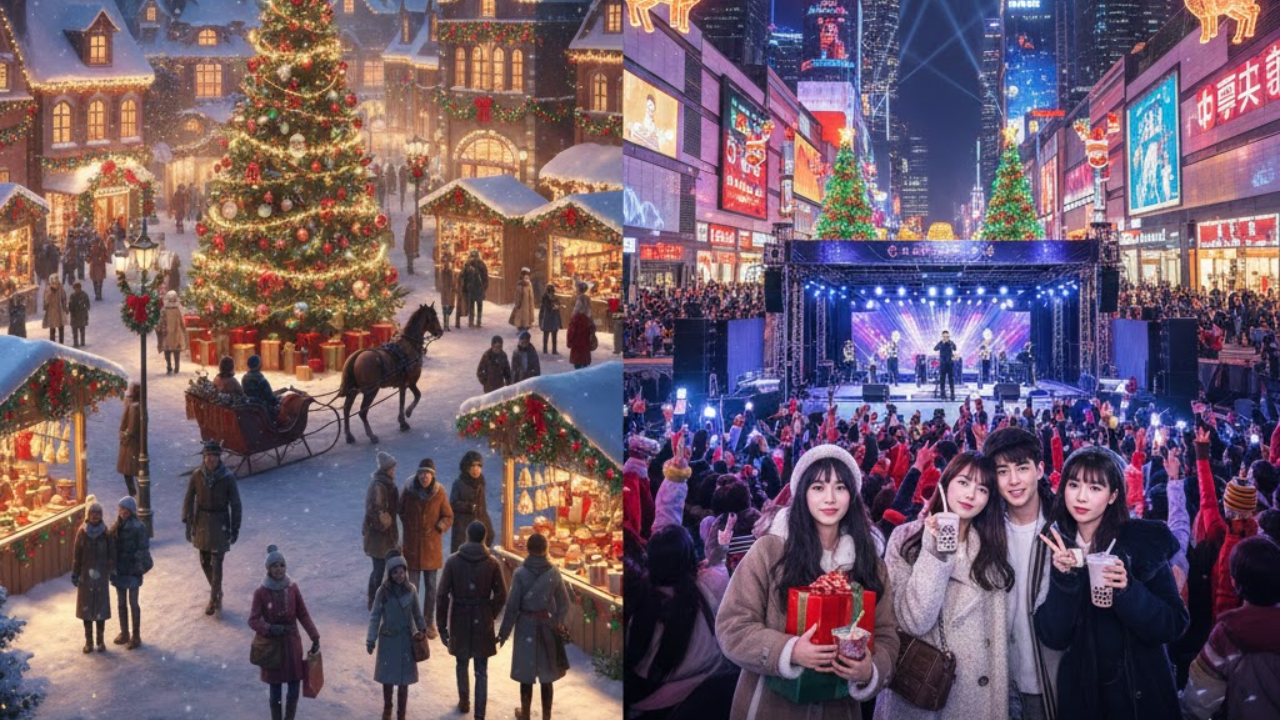
How Christmas in China Compares to the West: A Festive Tale of Two Traditions
Dec 05, 2025I'll never forget the first time I spent Christmas in Shanghai. I was wandering through a massive shopping centre on Christmas Eve, expecting the usual quiet streets I'd experience back home in Britain. Instead, I was greeted by throngs of young couples on dates, pop-up stalls selling roasted chestnuts, and the most elaborate Christmas decorations I'd ever seen, complete with a three-storey light display that would make Oxford Street jealous.
That's when it hit me: Christmas in China is an entirely different celebration. Let me take you through what makes it so fascinating.
It's Not Actually a Holiday (But You'd Never Know It)
Here's the thing that surprises most Westerners: Christmas isn't a public holiday in China. Only about 2-3% of China's population identifies as Christian, so 25th December is just another working day for most people. Schools are open, offices are buzzing, and life carries on as usual.
But, and this is a massive but, that hasn't stopped Christmas from becoming one of the most commercially celebrated occasions in Chinese cities. It's a bit like how we in the West celebrate Halloween without it being a religious observance. The festive spirit is very much alive, just reimagined through a distinctly Chinese lens.
Christmas Eve Takes Centre Stage
In the West, we build up to Christmas Day as the main event. We're up at the crack of dawn, ripping open presents, and tucking into a massive roast dinner with the family.
In China? Christmas Eve, or "Ping'an Ye" (平安夜), is where the action happens. The name literally translates to "Peaceful Night" or "Silent Night," and it's become the most celebrated part of the Christmas period. Young people treat it a bit like Valentine's Day: it's all about spending time with your romantic partner or going out with mates.
I remember walking through Beijing on Christmas Eve and seeing enormous queues outside restaurants and cinemas. Couples were everywhere, dressed to the nines, exchanging gifts and taking selfies in front of elaborately decorated shopping centres. It felt more like New Year's Eve in London than the cosy, family-centred affair I was used to.
The Apple Phenomenon
One of the most charming, and uniquely Chinese, Christmas traditions is the giving of apples on Christmas Eve. Yes, you read that right. Apples.
This tradition stems from a clever bit of linguistic wordplay. The word for apple in Mandarin is "píngguǒ" (苹果), which sounds similar to "píng'ān" (平安), meaning peace or safety. So giving someone an apple on Christmas Eve is essentially wishing them peace and safety for the year ahead.
But these aren't just any old apples from the fruit bowl. Oh no. In the lead-up to Christmas, you'll find beautifully packaged apples in shops—we're talking fancy boxes, ribbons, cellophane wrapping, the works. Some apples are even individually wrapped with festive designs and can cost the equivalent of £5-10 each! It's like giving someone a luxury gift, except it's fruit.
Back home, if someone gave me an apple for Christmas, I'd probably think they'd forgotten to go shopping. In China, it's a thoughtful, meaningful gesture.
The Food: No Turkey in Sight
Let's talk about Christmas dinner, because this is where things get really interesting. In the UK, we're slaves to tradition: turkey or goose, roast potatoes, Brussels sprouts, stuffing, and enough gravy to sink a battleship.
Chinese Christmas food? Completely different ball game.
For starters, there's no traditional "Christmas meal" that everyone sits down to. Since it's not a family holiday, people tend to go out to restaurants rather than cook at home. Western-style restaurants do a roaring trade, with KFC particularly cashing in on the festivities.
Yes, KFC. It might sound bizarre, but KFC has successfully marketed itself as the place to eat on Christmas in China. They offer special Christmas meal sets that need to be booked weeks in advance. We're talking queues around the block, folks. The meal typically includes fried chicken (obviously), a small cake, and sides. It's become so ingrained in Chinese Christmas culture that it's estimated millions of people eat KFC on Christmas Day.
For those not queuing at KFC, hotpot is another popular choice. Imagine gathering round a bubbling pot of spicy broth with your mates, cooking meat and veg together, laughing and chatting. It's convivial, it's fun, and it's delicious—just a world away from carving up a bird whilst wearing a paper crown.
I did meet some Chinese families who've embraced Western traditions and do roast a turkey or ham at home, but they're definitely in the minority. And even then, it might be served alongside traditional Chinese dishes like dumplings or noodles. Why not have the best of both worlds?
Present Opening: It's Complicated
In Western households, Christmas morning is sacred. Kids thundering downstairs at 5am, stockings bulging with goodies, presents piled under the tree, and the systematic destruction of wrapping paper that takes approximately four seconds per gift.
In China, gift-giving at Christmas is much more selective and happens differently. Since it's not a family holiday, you're not buying presents for your entire extended family. Instead, gift exchanges typically happen between:
- Romantic partners (this is the big one)
- Close friends
- Colleagues (though this is more common around Chinese New Year)
The gifts themselves tend to be practical or romantic rather than the eclectic mix we see in the West. Popular choices include:
- Tech gadgets and accessories
- Skincare and beauty products
- Designer accessories (scarves, wallets, etc.)
- Those fancy packaged apples I mentioned
- Chocolates and imported treats
And here's the kicker: there's no designated "present opening time" like we have on Christmas morning. Gifts are usually opened when they're received, often in restaurants or shopping centres. The focus is less on the anticipation and ritual of opening presents together, and more on the gesture itself.
I once watched a young man present his girlfriend with an elaborately wrapped box containing a designer handbag in the middle of a busy shopping centre, with other shoppers stopping to watch and take photos. It was treated as a public declaration of affection—something that would make most Brits squirm with embarrassment!
Decorations: More is More
If you think British high streets go overboard with Christmas decorations, wait until you see a Chinese shopping centre in December.
The decorations in major Chinese cities are absolutely spectacular. We're talking massive Christmas trees (often multiple stories high), elaborate light displays, enormous baubles, fake snow, the lot. Shopping centres compete to have the most impressive displays because, ultimately, Christmas in China is largely driven by commercial interests.
However, step outside the major cities and into smaller towns or rural areas, and you might not see a single decoration. The Christmas celebration is very much an urban, cosmopolitan phenomenon. This is quite different from the West, where even tiny villages will have a Christmas tree in the square and lights strung up along the high street.
No Religious Element (Usually)
In the UK, even for non-religious families, there's often some acknowledgment of Christmas's Christian roots—whether that's a carol service on the telly, "Silent Night" playing in shops, or nativity plays at school.
In China, the religious aspect is almost entirely absent from mainstream Christmas celebrations. You won't hear Christian hymns in shopping centres (though you'll hear plenty of "Jingle Bells" and "Last Christmas"). For the small Christian community in China, Christmas remains a religious observance celebrated in churches, but for the vast majority, it's a secular, commercial celebration.
It's All About Romance and Youth
Perhaps the biggest difference is who Christmas is for. In the West, it's overwhelmingly a family holiday. Multiple generations gather together, kids are the stars of the show, and there's a real emphasis on tradition and togetherness.
In China, Christmas has evolved into a holiday primarily for young people, especially young couples. It's trendy, it's exciting, and it's modern. Parents and grandparents generally don't get involved unless they're part of the small Christian community.
Think of it as a mashup of our Valentine's Day, New Year's Eve, and a big shopping event like Black Friday, all rolled into one festive package.
What This Teaches Us
Spending Christmas in China really opened my eyes to how traditions evolve and adapt when they cross cultures. The Chinese haven't simply adopted Western Christmas wholesale—they've taken elements they like and created something uniquely their own.
There's no "right" way to celebrate Christmas, really. Whether you're tucking into turkey with your nan in Lancashire, sharing hotpot with your partner in Chengdu, or queuing for KFC in Guangzhou, it's all about finding moments of joy, connection, and celebration in the darkest days of winter.
Though I must admit, I'm quite glad we don't have to book our Christmas dinner at KFC three weeks in advance back home. I'll stick with my slightly burnt roast potatoes and arguments over the Monopoly board, thank you very much.
But those fancy apples? I might just start that tradition myself.
Stay connected with news and updates!
Join our mailing list to receive the latest news and updates from our team.
Don't worry, your information will not be shared.
We hate SPAM. We will never sell your information, for any reason.
