
Can Learning Mandarin Help Children With Maths and Focus?
Aug 16, 2026Primary schools and nursery settings across Britain are contending with an unprecedented classroom challenge: the sharp decline in pupil attention spans and executive function. Recent reports from the Education Endowment Foundation (EEF) and early years developmental charities highlight an accelerating deficit in working memory, listening stamina, and spatial reasoning among Key Stage 1 and 2 cohorts.
Simultaneously, headteachers face intense scrutiny under Ofsted inspection frameworks to demonstrate ambitious curriculum breadth while lifting foundational numeracy and literacy standards.
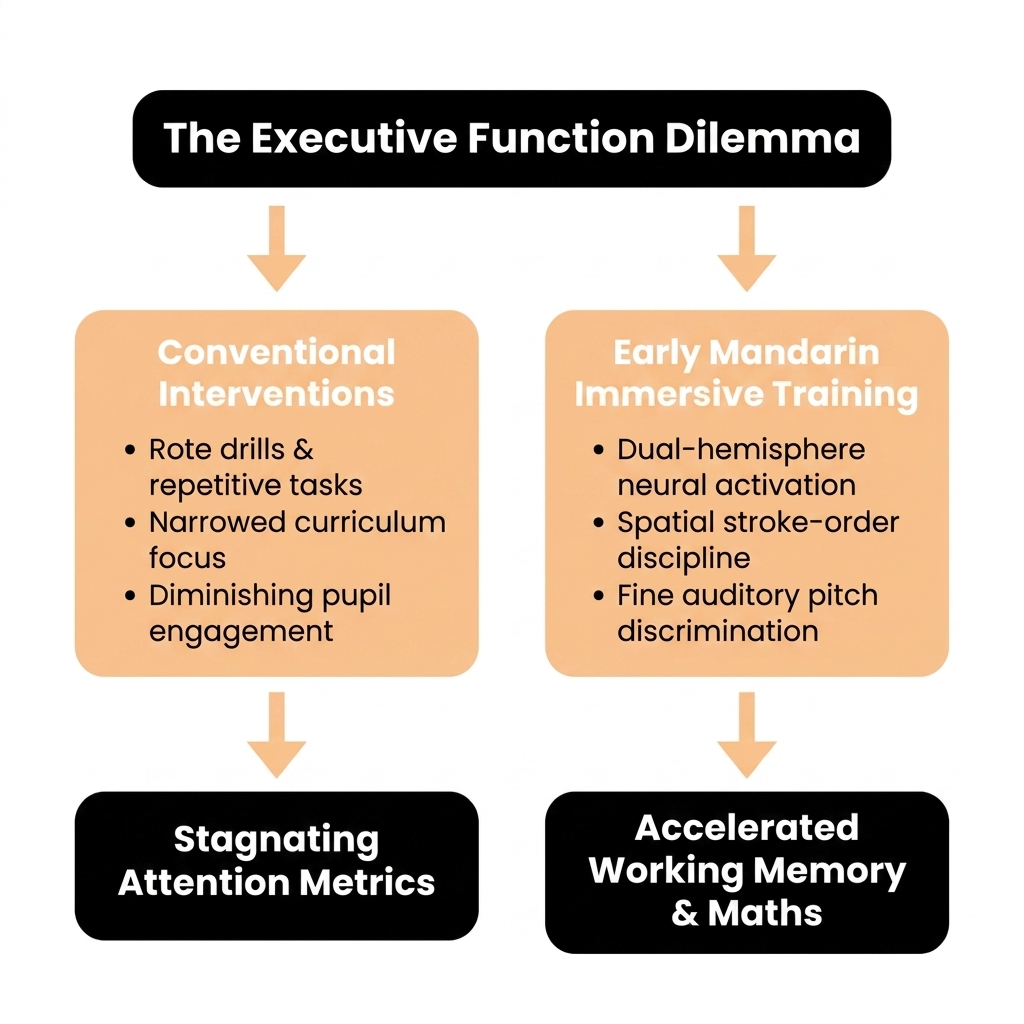
To solve this dilemma, a growing cadre of primary headteachers and nursery managers is looking beyond traditional educational interventions. Rather than doubling down on repetitive drills, they are adopting an approach supported by developmental neuroscience: early Mandarin language training.
Far from adding unnecessary pressure to early learners, evidence indicates that learning Mandarin acts as a powerful cognitive amplifier that elevates performance in core academic subjects.
The Neuroscience of the Logographic Mind
Modern foreign language teaching in the UK has long defaulted to Romance languages. However, neuroimaging trials conducted by researchers at University College London and Oxford University reveal that tonal, logographic languages engage the human brain in ways alphabetic scripts cannot replicate.
-
Dual-Hemisphere Neural Wiring: Processing English, French, or Spanish relies almost entirely on the left temporal lobe. In contrast, Mandarin requires the brain to decode phonetic meaning alongside tonal pitch variations, activating both the left and right temporal hemispheres simultaneously.
-
Spatial Memory and Mathematical Acceleration: Chinese characters are constructed through strict stroke sequences contained within two-dimensional visual grids. Research from the University of London demonstrates that character memorisation strengthens spatial working memory, the exact cognitive apparatus children rely on for early geometry, place value, and arithmetic problem-solving.
-
Auditory Attention Filtering: Mandarin incorporates four distinct vocal tones. Early auditory pitch training conditions pupils to filter subtle acoustic variations, leading to measurable improvements in classroom listening focus and English phonics acquisition.
|
Cognitive Domain |
Traditional Alphabetic MFL |
Mandarin Logographic MFL |
Primary Pupil Dividend |
|
Brain Processing |
Left temporal dominant |
Bilateral (Left and Right) |
Strengthens neural plasticity and cross-brain communication. |
|
Visual Architecture |
Linear 1D letter sequences |
Spatial 2D grid coordinates |
Directly trains spatial reasoning used in mathematics. |
|
Acoustic Focus |
Stress-timed cadence |
Tone-sensitive pitch variations |
Enhances working memory and auditory attention span. |
Erasing the Socio-Economic Attainment Gap
One of the most persistent operational headaches for school leaders is the baseline divide among incoming cohorts. Children from higher-income households often start Key Stage 1 with substantial advantages in vocabulary and European language exposure due to private enrichment or foreign travel.
Mandarin fundamentally neutralises this disparity.
Because virtually no British child has prior familiarity with Mandarin characters or pitch tones, every pupil starts from an identical baseline. Studies tracking early language uptake confirm that children eligible for Pupil Premium funding routinely achieve parity with their peers in Mandarin classrooms.
The visual, play-based nature of character recognition provides immediate success for pupils who struggle with standard phonetic reading. When previously disengaged pupils master a language universally acknowledged as challenging, their academic self-efficacy rises, driving renewed enthusiasm across numeracy and science.
"Mandarin removes inherited socio-economic head starts. Because every child begins at zero, it fosters an equal classroom environment that unlocks self-belief across every demographic."
(MANDO SCHOOL Inclusion and Performance Assessment)
Removing the Staffing Burden with Specialist PPA Cover
While primary leaders recognise the cognitive dividends of early Mandarin, recruitment shortages present a significant obstacle. Very few UK primary teachers possess native fluency or the specialist pedagogic training needed to teach Mandarin to four-to-nine-year-olds.
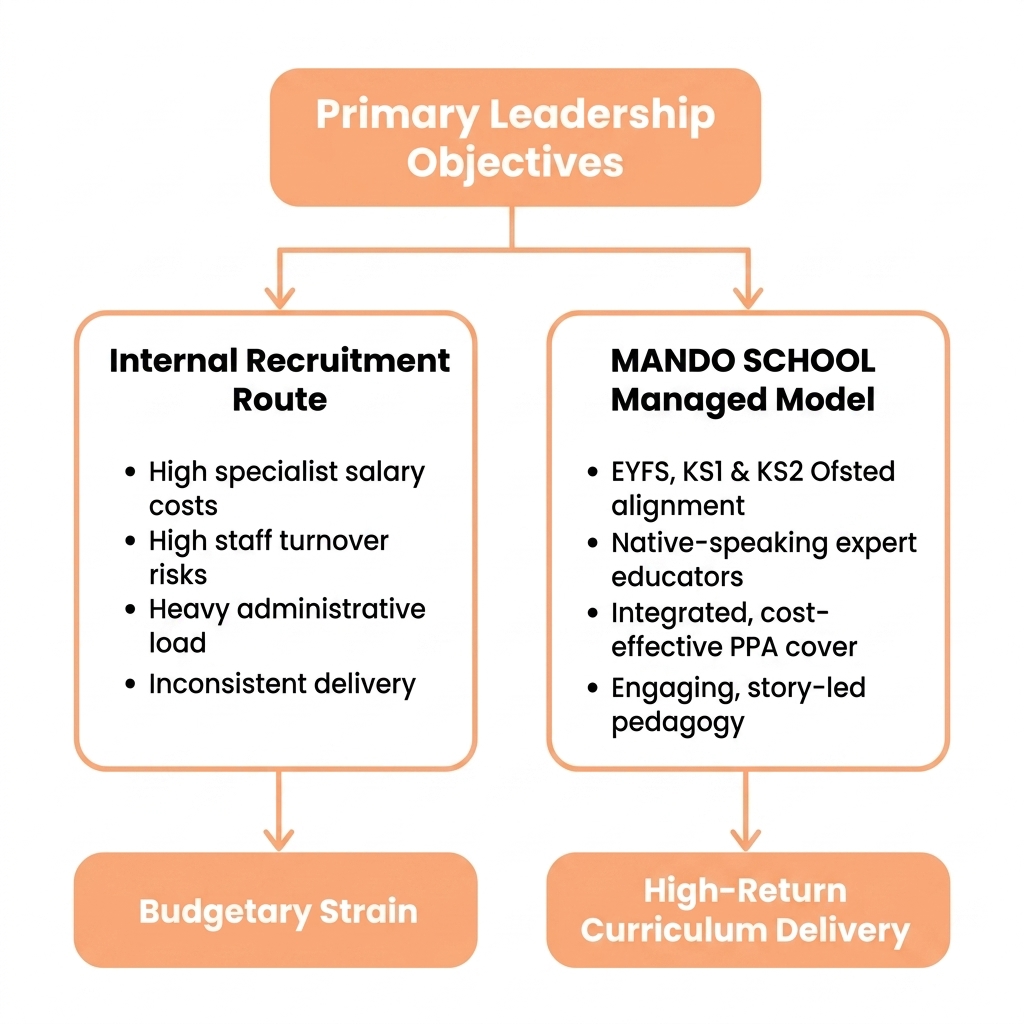
MANDO SCHOOL supports educational settings through flexible delivery structures:
-
Ofsted-Aligned MFL Programmes: Structured frameworks designed specifically for Early Years, Key Stage 1, and Key Stage 2.
-
Cost-Effective PPA Cover: Primary schools utilise specialist Mandarin teachers to deliver high-quality curriculum time while core teachers take planning and preparation time.
-
Nursery Enrichment Modules: Interactive, story-led sessions incorporating movement, songs, and physical character puzzles tailored for early communication development.
-
Self-Funding After-School Clubs: Extracurricular options that satisfy parental demand for enrichment without administrative burdens on school staff.
Strategic Distinction in an Aggressive School Market
Primary schools and nursery groups face increasing competition for pupil admissions. Modern parents are intensely focused on curriculum quality, cognitive outcomes, and future-readiness.
Offering Mandarin Chinese provides an immediate reputational differentiator. It demonstrates to prospective families, governors, and inspection bodies that the school leadership possesses a clear, modern vision for high-achievement learning.
Unlocking High Academic Yield
Tackling modern attention deficits and narrowing the numeracy gap requires innovative, evidence-led curriculum leadership. Introducing Mandarin through specialist partners like MANDO SCHOOL allows headteachers and nursery directors to elevate cognitive skills, support disadvantaged pupils, and enhance institutional standing.
To discover how MANDO SCHOOL can deliver tailored language lessons, nursery enrichment, or PPA cover for your setting, visit
Stay connected with news and updates!
Join our mailing list to receive the latest news and updates from our team.
Don't worry, your information will not be shared.
We hate SPAM. We will never sell your information, for any reason.
