
When Is Lunar New Year 2027? A Planning Guide for Schools and Nurseries
Oct 31, 2026Spring term feels a long way off, but if your school or nursery likes to mark Lunar New Year, now is a good moment to pencil it in. Here are the key dates for 2027, a simple planning timeline and some ideas for each age group, so the celebration feels calm, meaningful and well organised rather than a last-minute craft afternoon.
The key dates for 2027
- Friday 5 February 2027: New Year's Eve, traditionally a time for a big family reunion dinner.
- Saturday 6 February 2027: Lunar New Year's Day and the start of the Year of the Goat (you'll also see Sheep or Ram, which are accepted translations too). 2027 is a Fire Goat year.
- Saturday 20 February 2027: the Lantern Festival, on the 15th day of the new year, which closes the celebrations.
Because New Year's Day falls on a Saturday, most schools will celebrate on Friday 5 February or during the week of 8 February. February half term often falls around the middle of the month, so check your own term dates before you lock anything in. The festival season traditionally runs for about two weeks, so there's no need to squeeze everything into a single day.
Why it's worth doing well
The national curriculum for languages describes learning a foreign language as "a liberation from insularity" that "provides an opening to other cultures". A well-planned festival is one of the easiest ways to give children that opening, whether or not Mandarin is already on your timetable.
It also connects with life outside school. Visit London describes the capital's Chinese New Year events, centred on Chinatown and Trafalgar Square, as the largest outside Asia, drawing hundreds of thousands of people each year. In Manchester, the city council's 2026 programme included the annual Dragon Parade from Oxford Street to Chinatown, a lion dance in St Peter's Square and a Hong Kong Lunar New Year Market with more than 130 stalls. For lots of children, a classroom celebration links straight to something they might see with their family that weekend.
It's also a gentle introduction to a language with real reach. A British Council press release from July 2026 notes that Mandarin is the second most widely spoken language in the world, and that more than 18,000 pupils have taken part in the government-funded Mandarin Excellence Programme in secondary schools over its first ten years. A festival in Reception or Year 3 can be where that curiosity starts.
A simple planning timeline
November and December
- Add the dates to the school calendar and choose a format: a themed day, a week of activities, or a whole-school assembly plus class sessions.
- Ask families whether anyone celebrates and would like to share a tradition, a story or a recipe. Make it an invitation, never an expectation.
- If you'd like a Mandarin specialist to lead sessions, book early, as festival weeks fill up quickly.
Early January
- Order supplies: red card, gold paper, paper lanterns, chopsticks and tangram sets.
- Plan how the festival links to topics you already teach, such as calendars and the moon in science, celebrations in RE, or counting and pattern in maths.
Late January
- Teach a few greetings and songs in short daily bursts so children feel confident by the big day.
- Brief support staff and lunchtime teams if you're serving festival food, and check allergies.
Festival week
- Hold your celebration, share permission-cleared photos in the newsletter and keep things relaxed.
Around 20 February
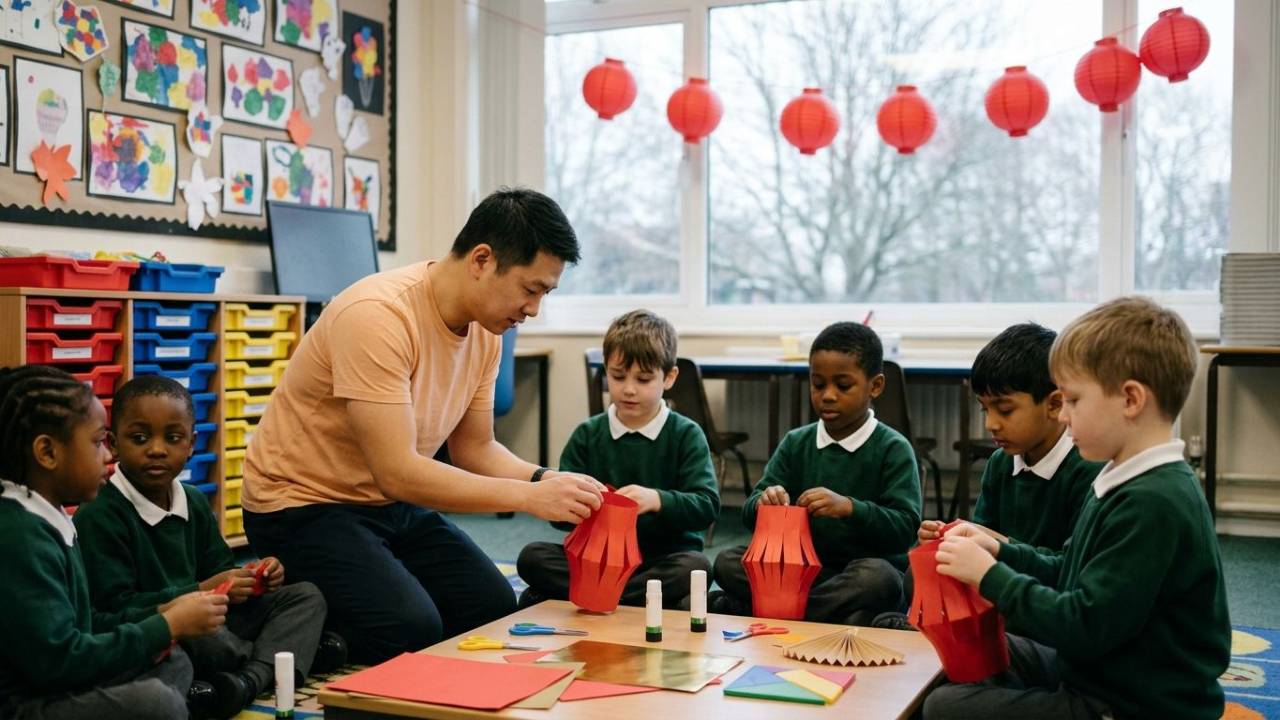
- Round things off with a lantern-making session for the Lantern Festival, if it fits around half term.
Ideas by age group
Nursery and EYFS
Keep it sensory and playful. Children can explore red and gold collage, practise picking up pom-poms with child-friendly chopsticks, listen to a short story about the zodiac animals and join in a simple "xīn nián hǎo" (Happy New Year) greeting song. Activities like these sit comfortably within Understanding the World and Expressive Arts and Design. You can read more about our playful early years Mandarin sessions on our nursery page.
Key Stage 1
Retell the story of the great race between the zodiac animals, put the animals in order and find out which animal belongs to each child's birth year. Try tangram puzzles, make paper fans and learn to count to ten in Mandarin with actions.
Key Stage 2
Older pupils can compare the lunar and Gregorian calendars, research how the festival is celebrated in different countries, design their own lantern, or prepare a short assembly with greetings and a lion dance. If Mandarin is your school's taught language, festival week is a lovely chance to show off what pupils can already say. Our page on Mandarin lessons and clubs in primary schools explains how specialist sessions can fit around your curriculum.
A few things to keep in mind
- Show the variety. Lunar New Year is celebrated in different ways across China and in other communities, such as Vietnamese families (Tết) and Korean families (Seollal). Showing that range helps more children feel included.
- Go beyond dragons. Family reunions, cleaning the house before the new year, red envelopes and sharing food are at the heart of the festival for many families.
- Get the language right. A couple of short, accurate greetings with the correct tones are worth more than lots of phrases learned in a rush. A native speaker can make a real difference here.
If you marked the Mid-Autumn Festival this term, many of the same resources (lanterns, stories, moon themes) carry straight over. Our guide on how to celebrate the Mid-Autumn Festival in your primary school has more ideas you can reuse.
Planning ahead pays off
A little thought in November makes February much easier: dates in the calendar, families invited, supplies ordered and sessions booked. Children remember festivals that feel joyful and real, and staff appreciate not having to scramble.
If you'd like a native-speaking Mandarin teacher to lead Lunar New Year sessions, a festival workshop or regular Mandarin lessons and clubs, we'd love to hear from you. Get in touch via mandoschool.com and we'll help you plan something that suits your school or nursery.
Sources
- Acad Calendar: Chinese New Year 2027, dates and the Year of the Fire Goat (New Year's Eve 5 Feb, New Year 6 Feb, Lantern Festival 20 Feb 2027)
- Office Holidays: Chinese New Year 2027 (6 February, Year of the Goat)
- Department for Education: National curriculum in England, languages programmes of study
- Visit London: Chinese New Year in London
- Manchester City Council: Lunar New Year celebrations in Manchester (2026)
- British Council press release, 1 July 2026: 18,000 students over 10 years of the Mandarin Excellence Programme
Stay connected with news and updates!
Join our mailing list to receive the latest news and updates from our team.
Don't worry, your information will not be shared.
We hate SPAM. We will never sell your information, for any reason.
