
Only 2% of UK Primary Schools Teach Mandarin, So Why Are Ofsted Inspectors Paying More Attention to the Ones That Do?
Sep 20, 2026Mid-Autumn Festival Is This Friday. Here's Why It's a Bigger Opportunity for Schools Than Most Realise
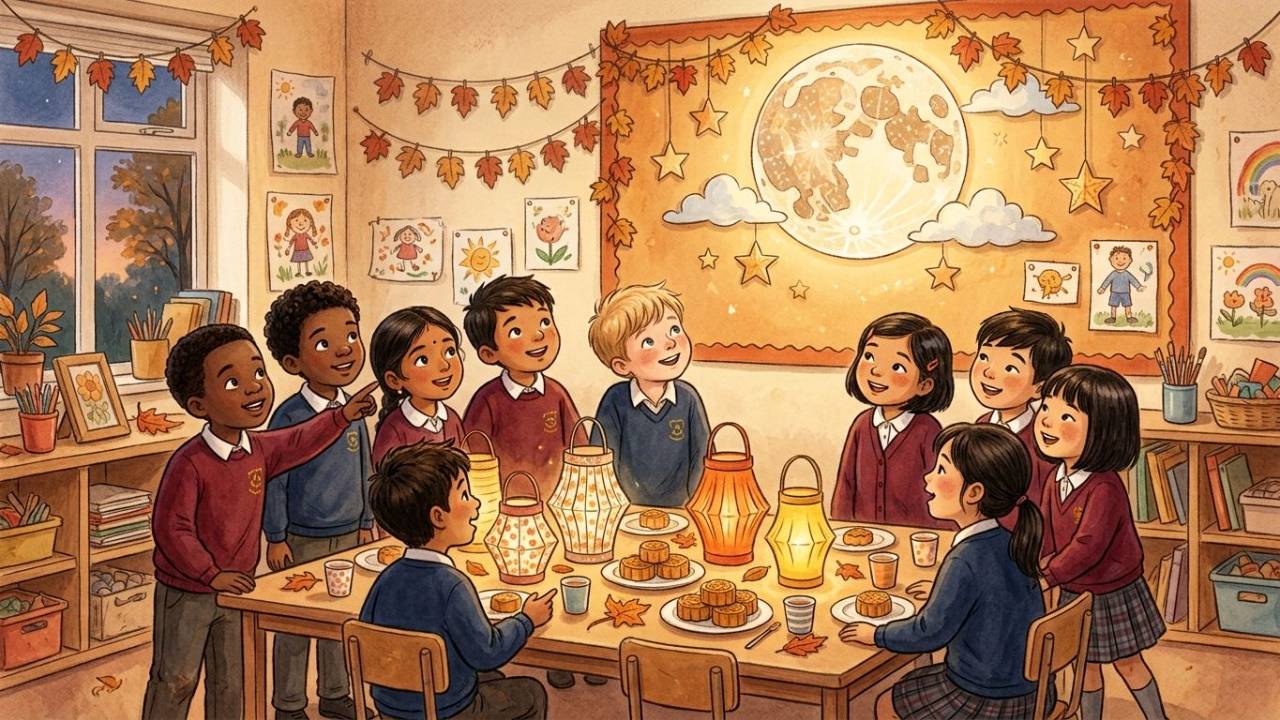
This Friday, 25 September, families across China and the Chinese diaspora will celebrate Mid-Autumn Festival, one of the oldest and most widely observed festivals in the Chinese calendar. The festival centres on the full moon, mooncakes, lantern riddles, and family reunion, marking gratitude for the year's harvest. For UK primary and nursery leaders, it's also a useful moment to look at where language provision sits on the timetable, and where the gaps are.
The numbers are more lopsided than most staffrooms assume
French remains the most taught language in English primary schools by some distance, at around 72 to 73% in recent years, with Mandarin sitting at just over 2%. That gap has stayed roughly the same for several years running. It's not that children aren't interested. A 2026 British Council survey found that more than two thirds of primary-age children would like to spend more time learning a language at school, and 85% said they find language learning fun. The three languages most primary pupils are actually learning are French, Spanish, and British Sign Language, so the appetite is there long before Mandarin ever gets offered as an option.
Why this matters for cultural capital, not just languages
Ofsted's inspection framework asks schools to demonstrate how they build pupils' cultural capital, the wider knowledge that helps children make sense of the world beyond their immediate experience. A festival like Mid-Autumn gives schools a genuine, low-lift way to do this: a short assembly on the story behind the festival, a class activity around lanterns or mooncakes, or a simple "moon gazing" discussion in Year 1 or 2 about the science and the folklore side by side.
It doesn't require a full Mandarin curriculum to be meaningful. But schools that do have ongoing Mandarin provision, even one weekly session, are usually the ones who can turn a one-off festival mention into a fuller unit of work: vocabulary for family, food and the moon, a bit of characters and pinyin for older year groups, and a genuine throughline pupils can build on year after year rather than a single assembly slide that's forgotten by half term.
The practical challenge for most schools
The honest reason most primaries don't teach Mandarin isn't lack of interest. It's staffing. Class teachers are already stretched across a full curriculum, and Mandarin specifically needs a native or near-native speaker to teach pronunciation and tones properly from the start, since mistakes learned early are hard to unlearn later. That's a different staffing problem to French or Spanish, where generalist cover is easier to find.
This is where a lot of schools we work with have landed on bringing in a specialist Mandarin instructor for a session a week, either as a curriculum-embedded MFL slot or a co-curricular after-school club, rather than trying to build capacity in-house from scratch.
What to do this week, even without a Mandarin programme in place
If nothing else, a Mid-Autumn Festival mention this week costs nothing and takes ten minutes to plan: a short story about the legend of Chang'e and the moon, a look at mooncakes and why they're shared, and a question for pupils about what their own families do to mark seasonal changes or harvests. Small, and worth doing well.
Stay connected with news and updates!
Join our mailing list to receive the latest news and updates from our team.
Don't worry, your information will not be shared.
We hate SPAM. We will never sell your information, for any reason.
