
How Learning Mandarin Builds Children's Listening and Memory Skills
Sep 06, 2026Primary education leadership in the UK has entered an era of data-driven decision-making. Headteachers and nursery directors routinely evaluate curriculum design not merely through tradition, but through measured educational return on investment.
Within this analytical framework, modern foreign languages (MFL) are being re-examined. Rather than treating second language learning simply as an isolated humanities subject, leading school leaders view it as a powerful cognitive intervention.
This perspective has driven significant interest in Mandarin Chinese across state primaries, multi-academy trusts, and early years settings. Supported by developmental neuroscience and cognitive psychology, introducing Mandarin to young learners offers measurable advantages for working memory, auditory focus, and curriculum equity.
The Science of the Dual-Hemisphere Brain
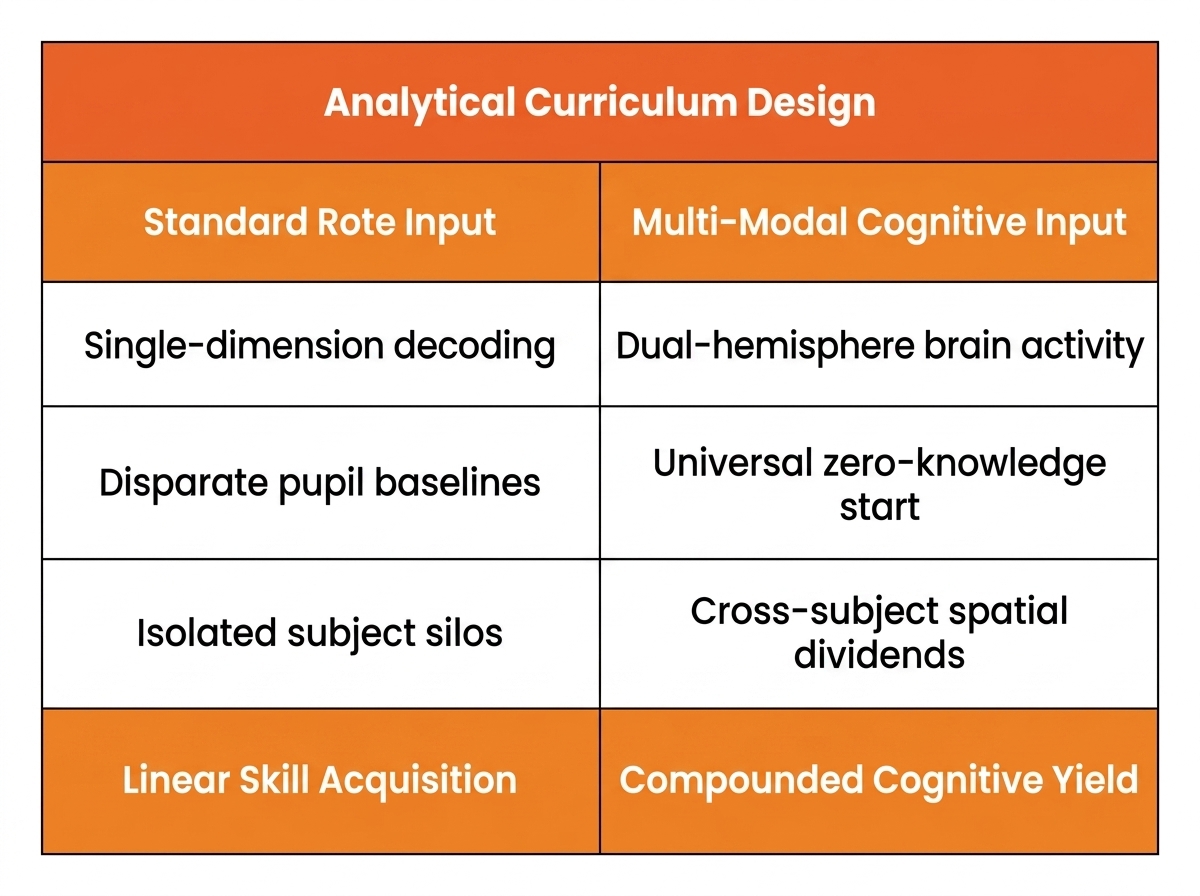
A central argument for introducing Mandarin during Early Years Foundation Stage (EYFS) and Key Stage 1 lies in the neurological architecture of the language itself. Most alphabetic systems are processed predominantly within the left temporal lobe of the human brain.
Mandarin Chinese operates through fundamentally different neural pathways.
-
Bilateral Brain Activation: Peer-reviewed neuroimaging studies published by Peking University and confirmed by researchers at University College London (UCL) show that interpreting Mandarin engages both temporal lobes. The left temporal lobe processes phonetic sound, while the right temporal lobe processes pitch and tonal inflection. Young children learning Mandarin receive a comprehensive workout across both hemispheres during a period of peak neural plasticity.
-
Visual-Spatial Working Memory: Unlike alphabetic scripts arranged in horizontal strings, Chinese characters are logographic structures built within two-dimensional spatial grids using precise stroke rules. A longitudinal study by the Institute of Education found that practising character formation significantly enhances spatial working memory. These same visual-spatial neural networks are directly recruited when children solve early arithmetic, fractions, and geometric tasks.
-
Acoustic Discrimination: Mandarin relies on four distinct spoken tones. Training the ear to detect fine pitch differences sharpens auditory processing. Educational researchers note that children trained in tonal discrimination show advanced phonemic awareness, helping them decode English phonics with greater precision.
|
Cognitive Domain |
Alphabetic Languages |
Logographic Tonal Languages |
Primary Educational Dividend |
|
Neural Wiring |
Left temporal dominant |
Bilateral (Left and Right lobes) |
Enhances cognitive agility and cross-brain plasticity. |
|
Spatial Architecture |
Linear horizontal sequences |
Grid-based stroke coordinates |
Reinforces working memory used in mathematics. |
|
Auditory Processing |
Stress-timed cadence |
Tone-sensitive pitch variations |
Sharpens listening focus and early phonemic decoding. |
|
Classroom Baseline |
Often skewed by home exposure |
Universal zero-knowledge baseline |
Establishes total equity for Pupil Premium cohorts. |
Classroom Equity: A Universal Zero-Knowledge Baseline
Narrowing the gap between disadvantaged pupils and their peers remains one of the primary benchmarks of school leadership. In many subjects, children from high-income households benefit from cultural advantages, such as travel, enriched home libraries, or early tutoring.
Mandarin acts as an effective equaliser within the classroom.
Because Mandarin shares no structural roots with English, virtually every pupil enters the classroom with zero prior knowledge. An analysis of early language programmes indicates that this universal starting point removes the intimidation often felt by less privileged pupils.
The multi-modal delivery of character learning, combining visual shapes, physical movement, and tonal rhythm, provides alternative learning pathways for visual and kinaesthetic learners. When children who struggle with conventional text discover that they can master a complex language, their academic self-efficacy rises significantly. This newfound confidence carries directly into reading, mathematics, and wider classroom participation.
"Mandarin levels the playing field naturally. Because every child starts from zero, it removes socio-economic advantage and nurtures academic self-belief across the entire cohort."
(MANDO SCHOOL Educational Assessment Framework)
Operational Efficiency: Turning PPA Budgets into Academic Assets
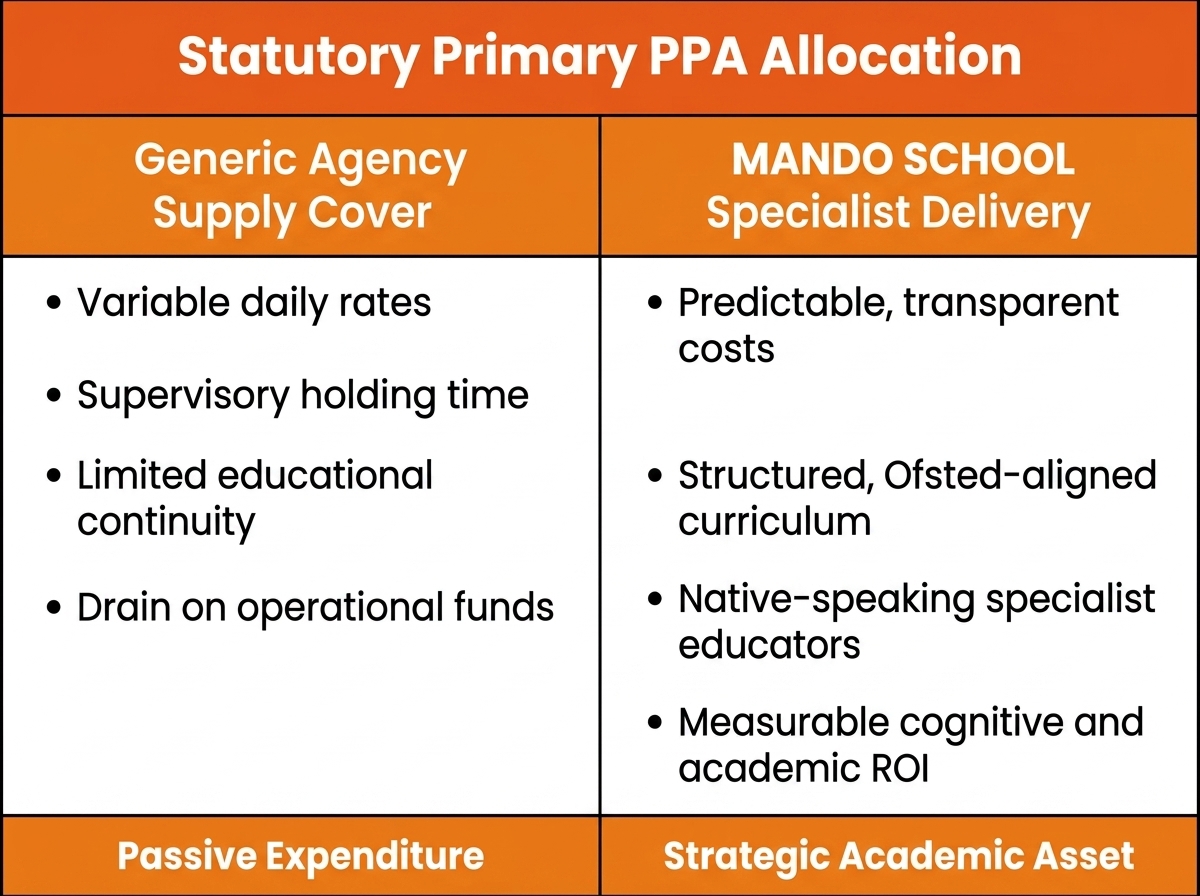
While the developmental case for Mandarin is clear, primary school leaders must navigate real operational constraints: staffing shortages, strict budget limitations, and statutory workload rules.
Few primary schools have the resources to recruit full-time language specialists.
MANDO SCHOOL integrates into primary and early years timetables through three core formats:
-
High-Impact PPA Cover: Primary schools deploy vetted, native-speaking educators to deliver structured Mandarin lessons, providing core teachers with their statutory Planning, Preparation, and Assessment (PPA) time while maintaining academic momentum.
-
Ofsted-Aligned Curriculum: Progressive schemes of work created specifically for Early Years, Key Stage 1, and Key Stage 2, using story-led adventures, movement, songs, and physical puzzles.
-
Extracurricular Enrichment: Turnkey breakfast, lunchtime, and after-school clubs funded by parents, allowing schools to expand enrichment without adding administrative workload.
Institutional Distinction and Community Confidence
In an increasingly competitive landscape, parents and school governors expect schools to demonstrate clear educational vision. Families seek environments that provide strong foundational skills alongside preparation for an interconnected global economy.
Introducing Mandarin signals forward-thinking leadership. It proves that a school or nursery is committed to evidence-based cognitive development, curriculum breadth, and high academic expectations.
For school leaders assessing their strategic priorities this term, partnering with
Related reading
Want to see this in practice? Read how our primary school programmes work, take a look at our free KS2 sample scheme of work, or see our page for Mandarin for schools and nurseries in London. You may also like how long it takes a child to learn Mandarin.
Stay connected with news and updates!
Join our mailing list to receive the latest news and updates from our team.
Don't worry, your information will not be shared.
We hate SPAM. We will never sell your information, for any reason.
